Process Intelligence
Proven in nuclear. Built for mining.
Non-intrusive flow characterisation for mineral processing slurry — from outside the pipe, without stopping the process. The Flow Characterisation System is the first Process Intelligence solution NuMetrik is commercialising for mineral processing and mining, built on 30 years of ultrasonic measurement proven in nuclear power generation.
The Technology
The Flow Characterisation System uses two arrays of ultrasonic transducers clamped to the outside of the pipe. Focused ultrasonic signals pass through the pipe wall into the flowing slurry. Turbulent structures and other non-uniformities in the flow modulate the received signals; by cross-correlating the upstream and downstream signal patterns, the system extracts the flow velocity of those structures — and therefore the bulk volumetric flow rate. Additional signal analysis derives further parameters without any penetration of the pipe wall.
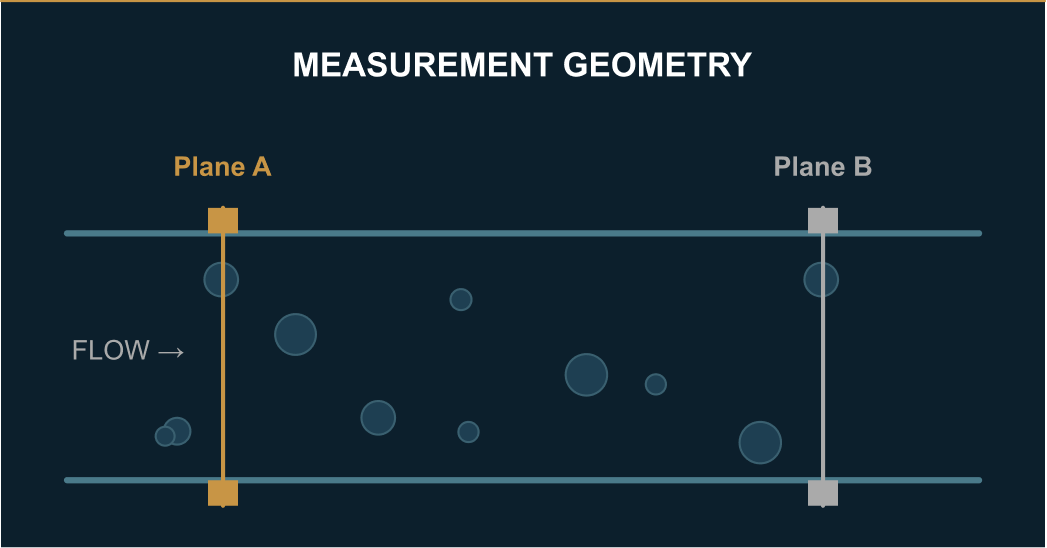
How It Works
Transducer arrays clamp to the outside of the pipe wall. Ultrasonic signals pass through the pipe wall into the slurry. No holes. No seals. No contact with the process stream. The pipe remains intact and the process continues uninterrupted.
The cross-correlation method is fundamentally independent of the properties of the flowing media, temperature, speed of sound, and pipe wall geometry — giving it a structural advantage in accuracy, robustness, and noise immunity over both intrusive and alternative non-intrusive flow measurement methods. The sensor never touches the slurry.
Measurement Capabilities
Parameters across three honest status tiers — deploy-ready, validation in progress, and R&D roadmap. We never conflate them.
Velocity measurement across the pipe cross-section — enabling circuit mass balance, pump performance monitoring, and flow regime characterisation.
Continuous volumetric flow measurement without pipe penetration. Critical for process accounting, tailings management, and circuit balance.
Non-intrusive monitoring of pipe wall condition — continuous wear tracking in high-erosion slurry environments without taking the pipe out of service.
Active R&D targets — signal processing algorithms for these parameters are in development and require laboratory and field validation under representative slurry conditions before deployment. Timeline for all roadmap parameters is subject to validation program outcomes. We will announce capabilities when and only when they are validated for the relevant conditions.
Replacing What Doesn't Work
In a typical mineral processing plant, the measurement roles the measurement system addresses are currently served by instrumentation with significant operational drawbacks. Understanding the substitution clarifies what you are actually gaining.
Radiometric gauges require radioactive source licensing, ongoing radiation safety program management, regulatory reporting, and eventual disposal of spent sources. The system's density measurement — currently in validation for mineral processing conditions — eliminates all radiological obligations from the density measurement function.
Magnetic flowmeters and differential pressure devices require pipe penetration and wetted components that erode in abrasive slurry. Maintenance intervals in slurry service are short; repairs require process interruption. The measurement system clamps to the outside — nothing contacts the slurry, nothing wears, and installation requires no pipe cutting.
Periodic sampling captures discrete data points in a continuously varying process. Excursions between samples are undetected. The measurement system provides a continuous measurement record — every minute of every shift, timestamped and available to process control systems, not just at sampling intervals.
Installation
the measurement system can be installed without shutting down the process — no pipe cutting, no welding, no commissioning downtime.
Pipe geometry, material, wall thickness, and slurry characteristics reviewed. Transducer mounting positions and integration details defined.
Transducer brackets clamped to the pipe exterior. No pipe penetration, no welding, no seal maintenance. Installation typically completed in a single shift.
Process unit calibrated to site-specific conditions. Signal quality verified. Baseline measurement established before data goes live.
Connectivity according to specified requirements.
Integration
Coming Soon
Validation Status
the system's cross-correlation measurement physics has been validated in nuclear power environments for 30 years by our technology partner. That record is the proof base — not a claim of automatic equivalence to mineral processing performance.
NuMetrik is actively pursuing a formal co-validation program with a recognised natural resource research institution to validate the measurement system specifically in mineral processing slurry conditions. We will publish measurement accuracy, repeatability, and drift data as that program advances.
In Practice
The measurement system addresses different measurement needs depending on where in the circuit it is deployed. Each scenario illustrates a distinct measurement challenge — from continuous wear tracking to reagent control to monitoring pump behaviour before problems develop.
SAG mill discharge lines carry high-velocity, high-solids slurry — the most erosive service in most plants. The measurement system is clamped to the discharge line, providing continuous volumetric flow data directly to the process control system while simultaneously tracking pipe wall thickness. Wear is recorded as a continuous trend rather than discovered at scheduled inspection intervals. Plant teams see the wear curve developing — not just the point where it crosses a threshold.
Feed consistency to the flotation bank is a direct determinant of reagent dosing efficiency. Once density measurement development for mineral processing conditions is complete, the measurement system will provide the continuous density and flow signal needed to close the reagent control loop in real time — replacing the hourly density sample with a measurement the control system can actually use. Volumetric flow measurement on flotation feed lines is deploy-ready now.
Note: Slurry density measurement is on the active R&D roadmap for mineral processing conditions.
Pump lines in slurry circuits produce acoustic signals that vary with operating conditions. The measurement system monitors these signals continuously, including patterns associated with early-stage changes in pump behaviour. Where acoustic signatures consistent with cavitation onset are present, they become visible in the data earlier than conventional vibration-based indicators — giving plant teams the opportunity to observe trends and respond before conditions deteriorate further. Cavitation prediction is an active R&D focus area; results will be published as the program advances.
Who Uses the measurement system
Different roles in a mineral processing operation have different questions. Find yours.
You run the circuit. You need measurement that works in slurry, doesn't shut down the process, and gives you data you can act on.
Recovery improvement and cost reduction. The ROI calculator gives you a framework to quantify the business case.
Embed intelligent measurement into your equipment and differentiate with process intelligence your customers can't get elsewhere.
Specify non-intrusive measurement for greenfield and brownfield projects, backed by independent validation data.
Join the co-validation program. Access novel instrumentation, shared data, and co-authorship on published results.
Continuous measurement replaces manual grab sampling — more defensible data for water, energy, and emissions reporting.
Tell us your pipe diameter, wall material, slurry characteristics, and what you're trying to measure. We'll tell you what's possible now and what's on the roadmap.